

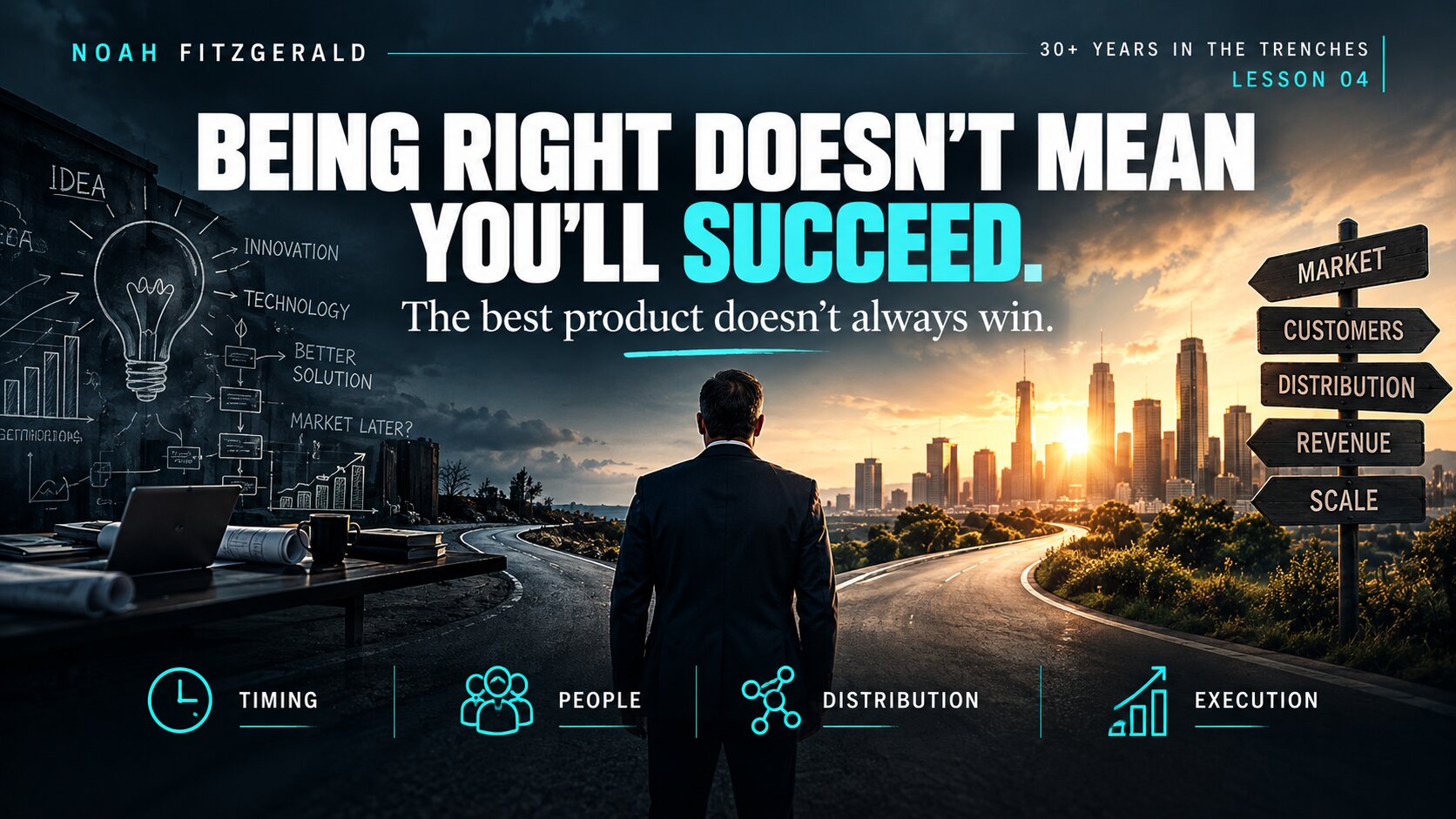
I've spent more than three decades in business, much of it in an industry that has experienced extraordinary technological transformation.
And if there's one thing I've learned about innovation, entrepreneurship, and building businesses, it's this:
You can be absolutely right about where the world is going and still be completely wrong about how to get there.
You can have the right idea.
The right technology.
The right solution to a legitimate problem.
You can even have customers telling you how badly they need what you're building.
And still fail.
That's one of the most frustrating realities of business. Especially for entrepreneurs, innovators, and people who see opportunities that others haven't recognized yet.
Because we tend to believe that if we build something better, the market will eventually reward us.
Sometimes it does.
But sometimes the market doesn't care that you're right.
And sometimes, by the time it does, someone else has figured out how to turn your idea into a successful business.
The Best Product Doesn't Always Win
Early in my career, I believed that having a superior product or solution created a significant competitive advantage.
And it does.
But I've come to understand that product superiority and business success are two very different things.
I've spent years working with payment technologies, software platforms, financial institutions, and businesses trying to solve complex problems.
The payments industry provides a remarkable illustration of this lesson.
Think about how many innovations have emerged over the last three decades.
Electronic payment gateways.
Integrated payments.
Mobile acceptance.
Contactless transactions.
Payment facilitation.
Embedded finance.
Open banking.
Artificial intelligence.
Many of these concepts existed long before they achieved meaningful commercial adoption.
The underlying ideas weren't necessarily wrong.
In some cases, the technology was already capable of delivering value.
But the market wasn't ready.
The infrastructure wasn't there.
The distribution channels hadn't developed.
The economics didn't work.
Or customers simply weren't willing to change.
Being technically possible is not the same as being commercially viable.
And being commercially viable doesn't automatically mean you know how to build a profitable, scalable business around it.
That distinction has become one of the most important lessons of my career.
Timing Is Everything. Except When It Isn't.
We often hear that timing is everything in business.
There's certainly truth to that.
Introduce a product too early, and you spend enormous amounts of money educating customers about a problem they don't yet recognize.
Introduce it too late, and you're competing against established players with stronger brands, deeper relationships, and more resources.
But timing alone doesn't explain success.
I've learned that businesses also need to recognize when the market is sending them a message.
Sometimes that message is:
"We're not ready."
Sometimes it's:
"We don't understand why this matters."
Sometimes it's:
"We like it, but we're not willing to pay for it."
And sometimes it's simply:
"We already have something that's good enough."
That last one can be especially difficult for innovators to accept.
Because entrepreneurs often evaluate products based on what they can do.
Customers evaluate them based on what they need, what they're willing to change, and whether the perceived benefit justifies the disruption.
Those are very different perspectives.
A product can solve a real problem and still fail to solve a problem customers consider urgent enough to pay for.
That's not necessarily a failure of innovation.
It's a failure to align innovation with market demand.
Distribution Can Beat Innovation
Here's a reality that many technology entrepreneurs don't want to hear.
A company with an inferior product and extraordinary distribution can outperform a company with superior technology and no effective way to reach customers.
I've seen the importance of distribution throughout my career in payments.
The relationships between financial institutions, processors, independent sales organizations, software providers, and merchants have always played an enormous role in determining which technologies gain adoption.
A solution doesn't succeed simply because it works.
Someone has to understand it.
Someone has to believe in it.
Someone has to sell it.
Someone has to implement it.
And ultimately, someone has to use it.
That requires far more than an impressive demonstration or a compelling pitch deck.
It requires trust.
Relationships.
Education.
Operational support.
Pricing that makes sense.
And a business model that rewards the people responsible for bringing the solution to market.
I've come to appreciate that distribution isn't just a sales function. It's part of the product's ability to succeed.
You can build the most sophisticated solution in the industry, but if customers can't discover it, understand it, buy it, or implement it, its commercial value remains limited.
The Dangerous Difference Between Validation and Revenue
One of the most important distinctions I've learned as an entrepreneur is the difference between people liking an idea and people actually buying it.
It's easy to get excited when prospective customers tell you that your product is amazing.
When industry executives praise your vision.
When potential partners express enthusiasm.
When investors tell you you're addressing a massive market opportunity.
Those conversations can be encouraging.
But enthusiasm isn't revenue.
Interest isn't commitment.
A verbal agreement isn't a signed contract.
And a signed contract doesn't always translate into successful implementation, adoption, or profitability.
I've learned to look beyond what people say about an opportunity and pay much closer attention to what they're willing to do.
Will they commit resources?
Will they change an existing process?
Will they introduce the solution to their customers?
Will they pay for it?
Will they continue paying for it?
Will they recommend it to others?
These are the questions that begin separating an interesting idea from a sustainable business.
The market validates a business through behavior, not compliments.
That lesson is especially important for founders who become so emotionally invested in their vision that they confuse encouragement with commercial traction.
And I understand why that happens.
When you've spent months or years developing something you believe in, you naturally want others to see what you see.
But belief, no matter how strong, doesn't pay the bills.
Execution Is Where the Truth Comes Out
In last week's 30+ Years in the Trenches, I wrote about why people are the most important ingredient in building a successful business.
This week's lesson is closely connected.
Because even when the idea is right, the market is ready, and the product delivers real value, someone still has to execute.
And execution is where the truth comes out.
Can the team deliver what was promised?
Can the business support customers after the sale?
Can leadership make difficult decisions when assumptions prove wrong?
Can the organization adapt when the market changes?
Can it manage capital, build sustainable economics, and maintain focus?
Can it turn early success into repeatable performance?
These are not glamorous questions.
They don't generate the same excitement as announcing a new technology, raising capital, or unveiling a bold vision.
But they determine whether a business survives.
I've learned that execution isn't about having the perfect plan.
It's about creating an organization capable of responding when the plan inevitably meets reality.
Because it will.
And the businesses that succeed aren't always the ones that predicted the future most accurately.
They're often the ones that adapted most effectively as the future unfolded.
The Cost of Being Too Attached to Being Right
There's another lesson here that I believe is particularly important for entrepreneurs and business leaders.
Sometimes our greatest obstacle isn't the market.
It's our own conviction.
Entrepreneurs need conviction.
Without it, many businesses would never get started.
You have to believe in something strongly enough to invest your time, money, reputation, and energy into making it real.
But conviction can become dangerous when it turns into an unwillingness to listen.
When every customer objection becomes proof that the customer doesn't understand.
When every missed sales target becomes someone else's fault.
When every competitor's success is dismissed because their product isn't as sophisticated.
When the original strategy becomes more important than the evidence suggesting it needs to change.
I've learned that there's a critical difference between being committed to a vision and being attached to a particular way of achieving it.
The vision can remain constant while the strategy evolves.
In fact, it often must.
Being adaptive doesn't mean abandoning your beliefs.
It means being willing to challenge your assumptions, acknowledge what isn't working, and change course before the cost of inaction becomes greater than the cost of change.
Sometimes the smartest thing a leader can say is:
"I still believe in where we're going. But I was wrong about how we were going to get there."
That's not weakness.
That's leadership.
What 33+ Years Have Taught Me
As I look back on my career, I recognize how much my perspective on success has evolved.
I've worked inside large organizations with extraordinary resources.
I've worked with entrepreneurs who had remarkable ideas and limited capital.
I've participated in the development and commercialization of technologies designed to change how businesses operate.
And I've learned that success is rarely determined by a single variable.
Product matters.
People matter.
Timing matters.
Distribution matters.
Capital matters.
Execution matters.
And the willingness to adapt matters enormously.
But there's one more ingredient that I believe deserves equal attention.
Humility.
The humility to recognize that the market doesn't owe us success because we believe our idea is better.
The humility to listen when customers tell us something we don't want to hear.
The humility to recognize that someone else may have found a better way.
And the humility to acknowledge that being right about the problem doesn't necessarily mean we're right about the solution.
After more than three decades in the trenches, I still get excited about innovation.
I still love challenging conventional thinking.
I still believe that extraordinary opportunities exist for those willing to see things differently.
But today, I'm far less interested in simply proving that an idea is right.
I'm interested in whether we can turn that idea into something that creates measurable value, earns customer trust, and builds a sustainable business.
Because ultimately:
Being right is an opinion until the market proves otherwise.
And even when the market agrees with you, success still has to be earned.
That's Business 101.
And it's a lesson I continue learning.
30+ Years in the Trenches is my weekly Wednesday series sharing experiences, perspectives, failures, and lessons from more than three decades in payments, fintech, entrepreneurship, and leadership.