

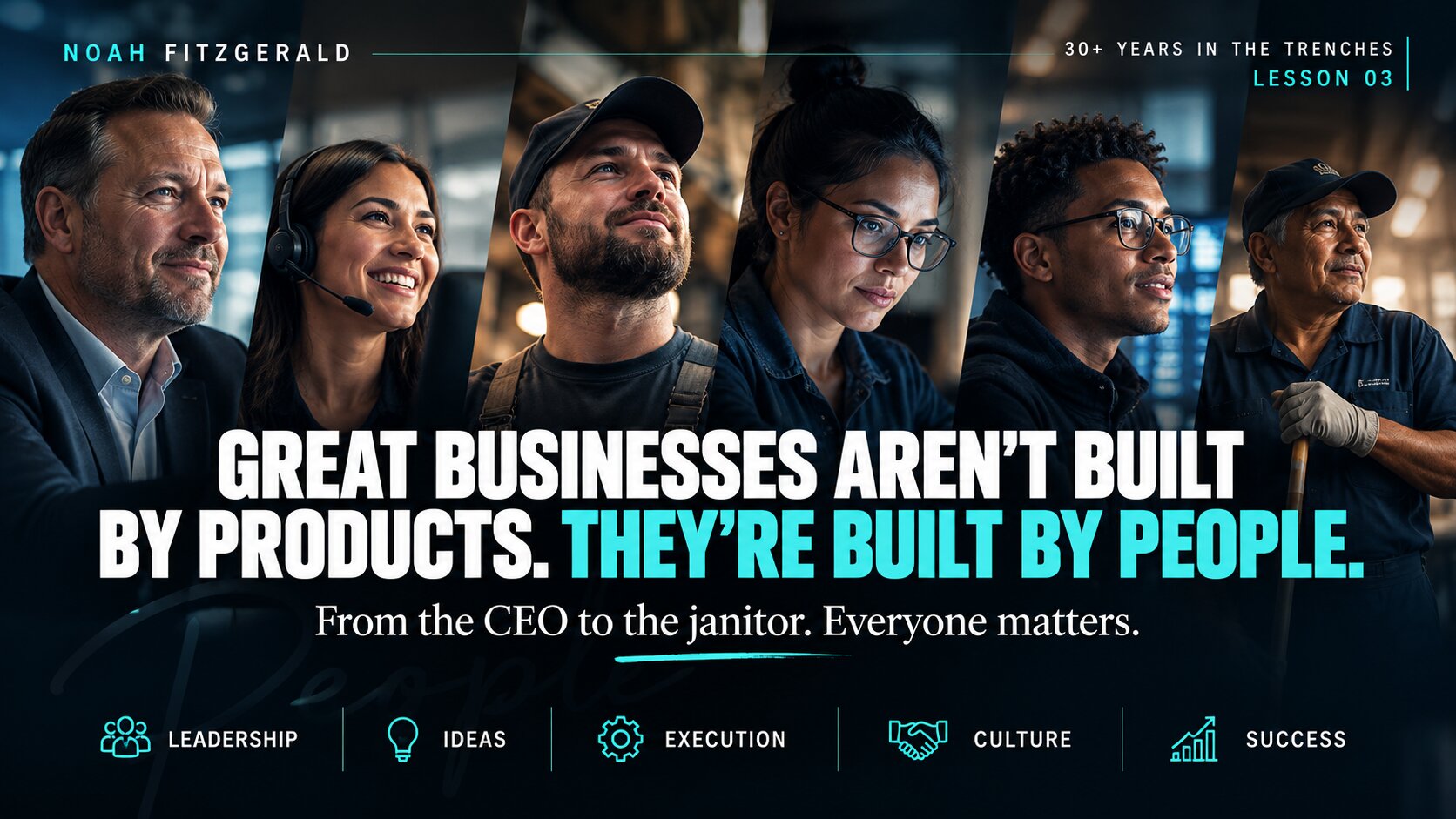
I've spent more than three decades building businesses, working inside some of the largest companies in the payments industry, helping startups find their footing, and watching organizations succeed, struggle, and sometimes fail.
And if there's one lesson that stands above nearly everything else I've learned, it's this:
The people you surround yourself with will have a greater impact on your success or failure than almost anything else.
Not the product.
Not the technology.
Not the timing.
Not even the capital.
Don't misunderstand me. All those things matter. A great product solves a real problem. Timing determines whether the market is ready. Processes create consistency. Capital provides the resources to execute.
But people are the ones who make all those things work.
Or don't.
And the longer I've been in business, the more convinced I've become that we dramatically underestimate just how much of a company's success or failure comes down to the human beings inside it.
The Business Success Formula Nobody Talks About Enough
We spend enormous amounts of time discussing product-market fit, competitive positioning, growth strategies, operational efficiency, and financial performance.
I've spent much of my career working on those exact challenges.
But here's what experience has taught me.
A brilliant strategy in the hands of the wrong people is just an expensive document.
A great product supported by a disengaged team becomes a mediocre customer experience.
A well-funded startup with toxic leadership can burn through millions of dollars while destroying the very culture it needs to succeed.
And an organization with extraordinary people can overcome challenges that would otherwise seem insurmountable.
I've seen enough over the years to believe that people aren't simply one ingredient in the formula for success. They're the multiplier that determines the effectiveness of everything else.
You can improve a product.
You can redesign a process.
You can adjust a strategy.
But when the people responsible for executing those things lack integrity, accountability, curiosity, or commitment, the entire business suffers.
From the CEO to the Janitor
One of the biggest mistakes businesses make is assuming that the most important people are the ones with the biggest titles.
CEOs. Presidents. Founders. Executives. Board members.
Certainly, leadership matters enormously. A single poor leadership decision can have consequences that ripple through an entire organization.
But I've also learned that some of the most important people in a business have no impressive title at all.
They're the customer service representative who refuses to let a customer down.
The operations employee who notices something isn't right before it becomes a major problem.
The developer who challenges a bad product decision.
The salesperson who tells a prospect the truth, even when it costs them a commission.
The administrative professional who quietly keeps the entire organization functioning.
And yes, even the janitor who takes pride in maintaining the environment where everyone else works.
Every person contributes to the experience a company delivers.
Every person has the potential to strengthen or weaken its culture.
And every person deserves to understand how their work contributes to the organization's success.
A company isn't defined by what its leadership says in the boardroom. It's defined by what its people do when leadership isn't watching.
Why I've Watched Every Episode of Undercover Boss
There's a television show I've watched religiously over the years: Undercover Boss.
In fact, I've watched every episode.
And while it's entertainment, there's something about the underlying premise that has always resonated with me.
A CEO or senior executive goes undercover inside their own organization, working alongside employees in the trenches.
What happens next is often remarkably revealing.
They discover employees who care deeply about their customers and coworkers.
People who go above and beyond despite difficult circumstances.
People with ideas that could improve the business, but who have never been asked.
They also discover broken processes, poor management, inadequate training, and situations where the corporate view of the business bears little resemblance to what employees experience every day.
And almost inevitably, the executive comes away with a different appreciation for the people who actually make the organization work.
That's the part that fascinates me.
Why does it take going undercover for some leaders to discover the truth about their own companies?
Why aren't they already spending time with the people closest to the customers?
Why aren't they listening?
Why aren't they asking what needs to change?
You shouldn't need a television crew and a disguise to understand your own business.
And perhaps the most important lesson is that the people closest to the problems are often the people closest to the solutions.
The Wrong People Can Destroy the Right Business
There's another side to this conversation that we don't discuss enough.
People can also destroy businesses.
Sometimes through deliberate misconduct.
Fraud. Embezzlement. Theft. Dishonesty. Misrepresentation.
Other times, the damage is less obvious but just as corrosive.
Toxic leadership.
Egos that become more important than the mission.
Managers who protect their positions rather than develop their teams.
Employees who undermine colleagues.
Executives who refuse to accept accountability.
Founders who surround themselves with people who agree with everything they say.
Organizations where fear replaces communication and politics replaces performance.
These behaviors don't always appear on a financial statement immediately.
But their consequences eventually do.
Lost employees. Lost customers. Missed opportunities. Poor execution. Damaged reputations. Wasted capital.
And sometimes the ultimate failure of the business itself.
I've come to believe that one of the most expensive mistakes a leader can make is keeping the wrong person in a critical role for too long.
Not because difficult people should automatically be discarded. People deserve feedback, coaching, development, and opportunities to improve.
But there comes a point where protecting one person's behavior means asking everyone else to absorb the consequences.
Accountability isn't the opposite of compassion. It's one of the ways we protect the people who are doing the right things.
Great People Need More Than a Paycheck
Of course, attracting the right people is only part of the challenge.
You have to create an environment where they can thrive.
That requires more than compensation, benefits, and an occasional company appreciation event.
People want to feel respected.
They want to understand the mission.
They want their contributions to matter.
They want opportunities to grow.
They want leaders who listen, communicate, and follow through on commitments.
And they want to work alongside people they can trust.
Some of the most valuable investments a company can make aren't in technology or marketing.
They're in developing its people.
Training. Mentorship. Leadership development. Personal growth. Better communication. Stronger relationships.
I've long believed that investing in ourselves is one of the highest-return investments we can make.
The same principle applies to organizations.
When you help people become better versions of themselves, you aren't simply improving employee performance.
You're strengthening the foundation of the entire business.
The People You Surround Yourself With Matter Just as Much
This lesson isn't limited to employees.
It's about cofounders.
Business partners.
Investors.
Advisors.
Customers.
Mentors.
And the people you turn to when things aren't going according to plan.
One of the most important things I've learned is to surround myself with people who bring different perspectives, complementary strengths, and the willingness to challenge my thinking.
I don't need people who agree with everything I say.
I need people who care enough to tell me when I'm wrong.
People who will hold me accountable.
People who will challenge assumptions.
People who bring skills and experiences I don't have.
And, above all, people who operate with integrity.
Because when business gets difficult—and it always does—those are the relationships that matter most.
What 33+ Years Have Taught Me
I still believe in innovation.
I still believe in building extraordinary products.
I still believe timing, strategy, processes, and execution are critical.
But I've learned that none of those things operates independently of people.
People create the products.
People develop the strategies.
People execute the processes.
People build the relationships.
People solve the problems.
And people determine how an organization responds when things go wrong.
So when I evaluate a business today, I certainly want to understand its technology, financial performance, competitive position, and market opportunity.
But I also want to understand its people.
Who's leading?
Who's executing?
Who's challenging assumptions?
Who's taking accountability?
Who's protecting the culture?
And who's quietly holding everything together without getting the recognition they deserve?
Because after more than three decades in the trenches, I've become convinced of something remarkably simple.
Great people can make a good business extraordinary. The wrong people can make an extraordinary opportunity disappear.
Business 101.
And perhaps one of the most important lessons of all.
30+ Years in the Trenches is my weekly Wednesday series sharing real-world perspectives, experiences, failures, and lessons from more than three decades in payments, fintech, entrepreneurship, and leadership.