

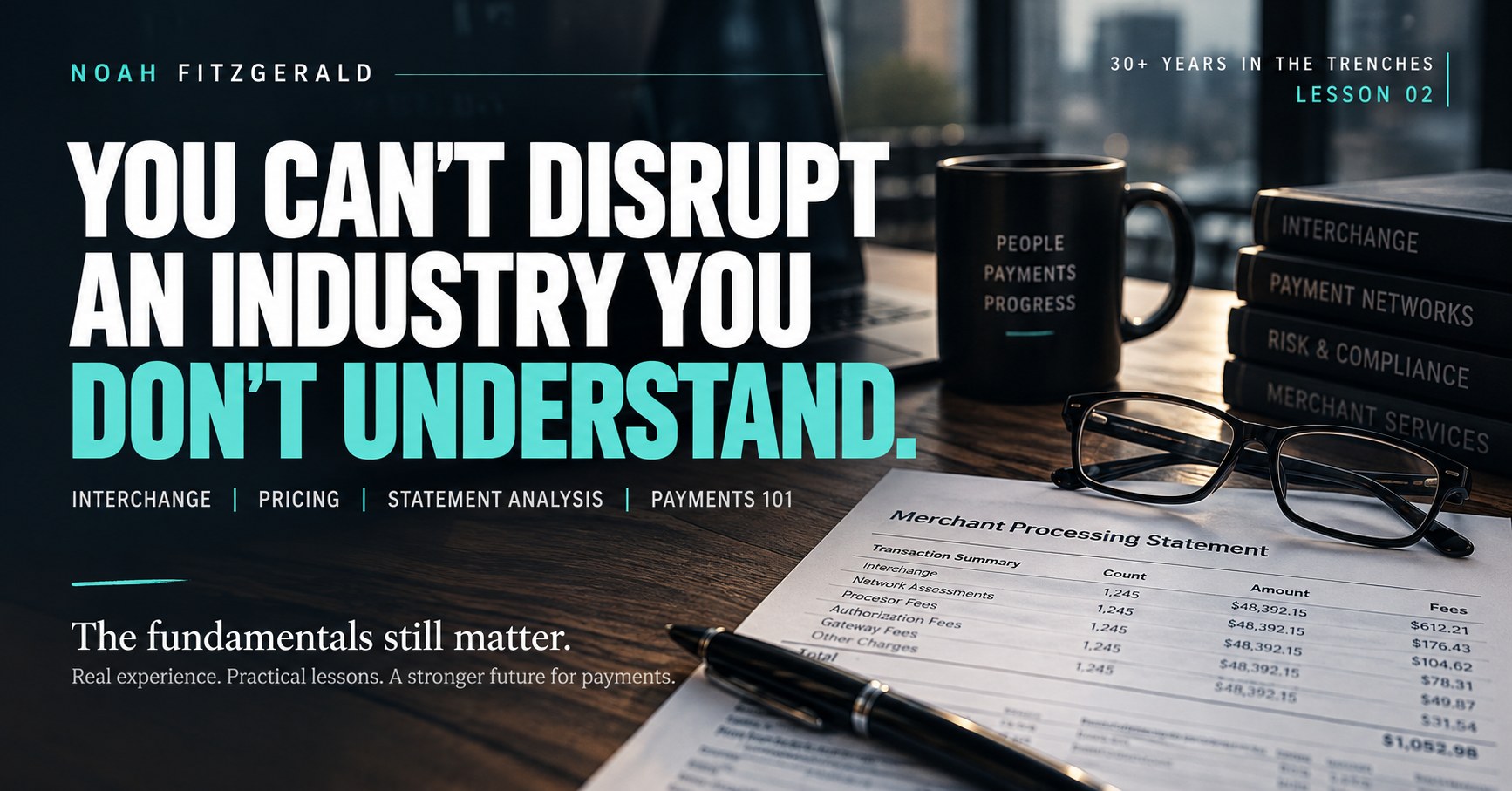
I've spent more than three decades in the payments industry, and there's something I've been noticing that genuinely concerns me.
We have more technology, more fintech companies, more payment facilitators, more embedded payment solutions, and more people talking about revolutionizing payments than at any point in my career.
Yet I regularly encounter people working in payments who struggle to explain how a credit card transaction actually works.
Not how to integrate an API.
Not how to demonstrate a payment terminal.
Not how to sell a merchant account.
I'm talking about the fundamentals.
Interchange. Assessments. Authorization. Clearing. Settlement. Pricing structures. Merchant statements. Cost analysis.
The actual mechanics and economics of moving money.
And I believe our industry is paying a price for losing sight of those fundamentals.
When Understanding Payments Wasn't Optional
When I entered the payments industry in 1992, the world looked very different.
Payment terminals were considerably less sophisticated. E-commerce was barely emerging. Mobile payments weren't part of the conversation. And the idea of accepting payments through a smartphone would have sounded like science fiction.
But one thing was absolutely essential: you needed to understand the business.
You needed to know how transactions moved through the ecosystem, who participated in the process, how each participant made money, and how those costs ultimately affected the merchant.
You needed to understand interchange.
You needed to understand the difference between wholesale processing costs and the fees a merchant was actually paying.
And if you were going to walk into a business and recommend a payment solution, you had better understand how to read its processing statement.
That knowledge was foundational to becoming a credible payments professional.
Today, I wonder how many people entering the industry are being taught those same fundamentals.
Interchange Isn't Just Another Fee
Let's start with interchange.
It's one of the most important economic components of card payments, yet it's also one of the most misunderstood.
Interchange is generally a fee established by the card networks and paid by the acquiring side of a transaction to the card-issuing bank. The applicable rate can vary based on the card product, merchant category, transaction characteristics, and other factors.
It's not simply a rate that a processor makes up.
It's not the same thing as a processor's markup.
And it's certainly not the only cost involved in accepting a card payment.
Then there are network assessments, processing fees, authorization costs, gateway fees, and other potential charges.
Each plays a different role.
Yet I continue to see interchange, assessments, processor markup, and other charges treated as though they're all the same thing.
They're not.
And if you don't understand the difference, how can you meaningfully evaluate a merchant's processing costs?
More importantly, how can you recommend a better solution?
The Lost Art of Reading a Merchant Statement
Here's something I believe every payments professional should be able to do.
Sit down with a merchant processing statement and explain exactly what's happening.
Not just point to the effective rate.
Actually understand the statement.
How much volume was processed?
How many transactions?
What was the average ticket?
What interchange categories were applied?
What network fees were charged?
How much of the total expense was attributable to underlying card acceptance costs, and how much represented processor markup or additional services?
Were there downgrades or avoidable qualification costs?
Are the pricing structures transparent?
Are there fees that warrant further investigation?
And perhaps most importantly, does the pricing model make sense for the merchant's actual business?
A merchant processing statement isn't just a bill.
It's a financial and operational record of how a business accepts payments.
When you understand how to analyze it, you can uncover opportunities that go well beyond negotiating a few basis points.
You can identify operational inefficiencies, pricing problems, transaction-routing issues, and opportunities to improve how payments are managed.
But none of that happens if you don't understand what you're looking at.
We've Made Selling Payments Easier. Have We Made Understanding Payments Harder?
Technology has fundamentally changed how payment solutions are sold and deployed.
And much of that progress has been extraordinary.
Today, companies can integrate payments through APIs, onboard merchants digitally, automate underwriting, deploy sophisticated fraud tools, and embed payment acceptance directly into software platforms.
Those are meaningful advances.
But there is a difference between knowing how to sell a payment product and understanding the payments business.
Someone can be excellent at selling an integrated payment solution without understanding interchange qualification.
A developer can build an outstanding payment integration without understanding the economics behind the transaction.
A fintech founder can raise millions of dollars around a payment innovation without fully appreciating the relationships among issuing banks, acquiring banks, networks, processors, and merchants.
Those skills are valuable. But they are not interchangeable.
And when foundational knowledge is missing, the consequences eventually show up somewhere.
In pricing.
In product design.
In merchant profitability.
In risk management.
In partnerships that don't work the way everyone expected.
And sometimes in business models that looked brilliant until the underlying economics caught up with them.
The Fundamentals Still Matter, Even When Everything Else Changes
Over my career, I've watched payments evolve through enormous technological shifts.
From traditional terminals and dial-up authorization to e-commerce gateways, integrated payments, mobile acceptance, contactless technology, and increasingly sophisticated financial infrastructure.
I've had opportunities to participate in several of those transitions.
And one lesson continues to stand out.
Technology changes how payments happen. It doesn't eliminate the need to understand why the system works the way it does.
In fact, as payment infrastructure becomes more complex, understanding the fundamentals becomes even more important.
Take embedded payments.
If you're building a software platform that monetizes payment acceptance, you need to understand the underlying economics.
Take payment facilitation.
If you're assuming responsibility for onboarding, risk, compliance, and merchant relationships, you need to understand the operational and financial implications.
Take AI-driven payment optimization.
If you're building technology to analyze fees, improve authorization performance, or identify inefficiencies, you need to understand what the underlying data actually represents.
Automation can accelerate analysis.
It cannot compensate for a fundamentally incorrect understanding of the business.
My Advice to the Next Generation of Payments Professionals
If you're early in your payments career, I would encourage you to invest time in learning the business from the ground up.
Understand the transaction lifecycle.
Learn the roles of issuers, acquirers, processors, gateways, networks, and other participants.
Study interchange and network assessments.
Understand different merchant pricing structures.
Learn how to read and analyze processing statements.
Understand why authorization, clearing, and settlement are distinct processes.
Learn how chargebacks, fraud, underwriting, and compliance influence the economics of the industry.
And don't just memorize terminology.
Understand how the pieces connect.
Because once you understand the fundamentals, you can begin to recognize where the system is inefficient, where merchants are underserved, and where meaningful innovation is possible.
That's when you stop simply participating in the payments industry and start understanding how to improve it.
After 33+ Years, I'm Still Learning
One of the things I appreciate most about payments is that there's always something new to learn.
New technologies.
New regulations.
New business models.
New risks.
New opportunities.
And I certainly don't pretend to have all the answers.
But I do believe that decades of experience have reinforced one principle that is too often overlooked.
You cannot build a better future for an industry without understanding the foundations on which it was built.
We need more innovation.
We need more entrepreneurs.
We need more people willing to challenge how things have always been done.
But we also need more people who understand the business behind the technology.
Because innovation without foundational knowledge isn't always disruption.
Sometimes it's just a more sophisticated way to make the same old mistakes.
30+ Years in the Trenches is my weekly Wednesday series sharing personal perspectives, experiences, failures, and lessons from more than three decades in payments, fintech, and entrepreneurship.
I'd love to hear your perspective: Are we doing enough to teach the fundamentals of payments to the next generation of professionals, or have we become too focused on selling the technology?