

I've spent more than three decades in the payments industry.
During that time, I've watched technologies emerge, industries transform, entire business models disappear, and new opportunities materialize that nobody could have imagined just a few years earlier.
I've experienced the evolution of the personal computer, the internet, e-commerce, mobile payments, smartphones, social media, and countless other innovations that fundamentally changed how we live and work.
Some of those transformations I watched from the sidelines. Others I had the opportunity to help pioneer.
And with every significant shift, one thing remained constant.
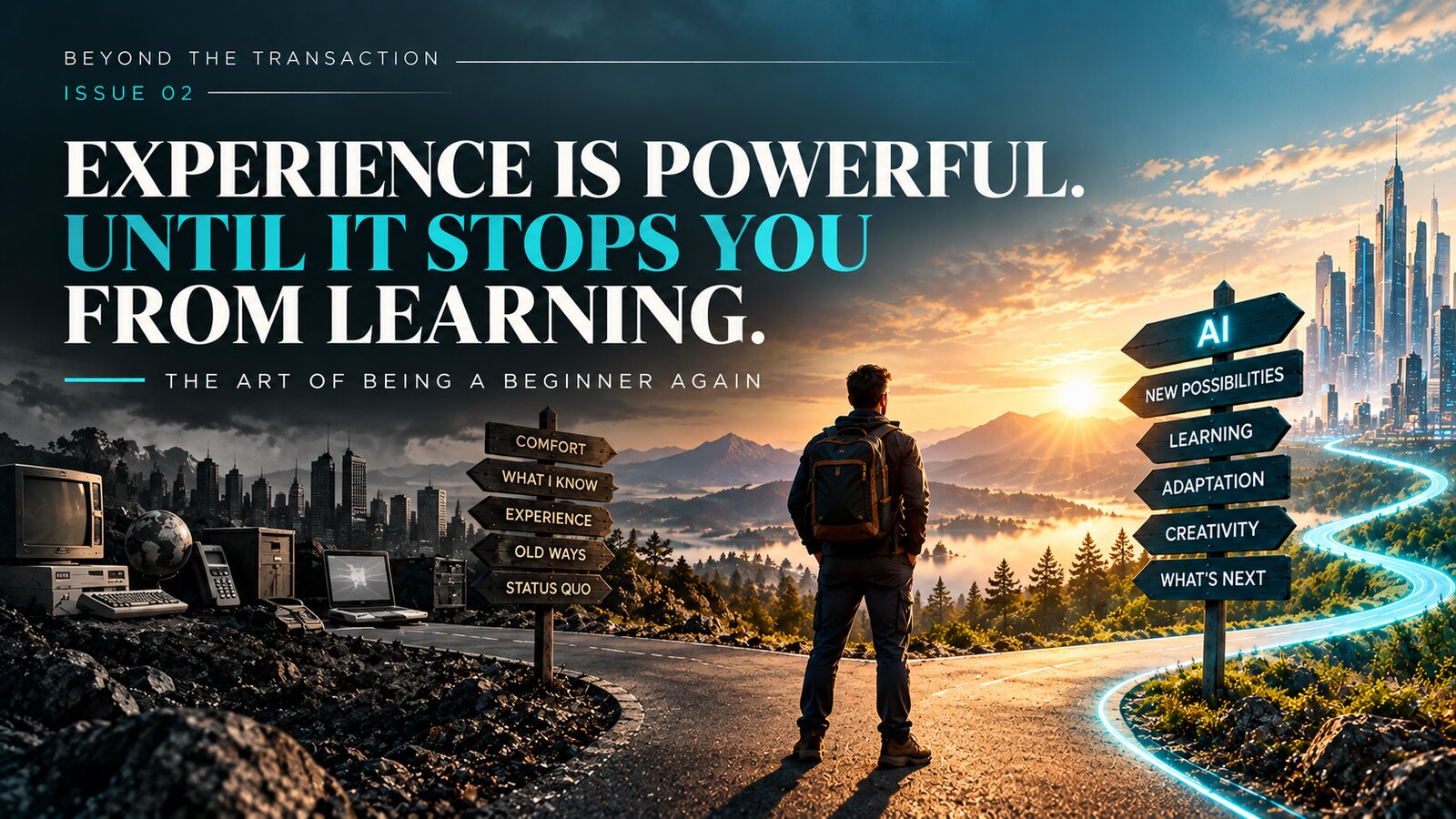
I had to become a beginner again.
It didn't matter how much experience I had accumulated, how many companies I'd helped build, or how well I understood the industry.
When the rules changed, I had to learn something new.
And here we are again.
Except this time, the transformation feels different.
Welcome to the Age of Artificial Intelligence.
The Uncomfortable Reality of Knowing What You Don't Know
I've been using ChatGPT for roughly two years.
When I first started, like many people, I was curious about what it could do. I experimented, asked questions, explored capabilities, and slowly began incorporating it into my daily work.
Over time, I became comfortable enough to use it for research, writing, strategy, analysis, and solving problems.
I felt like I was getting pretty good at it.
And then something interesting happened.
The technology started advancing faster than I could keep up.
New models. New platforms. AI agents. Autonomous workflows. Coding assistants. Image and video generation. Entire applications being built through conversations.
Every day, another announcement.
Every week, another breakthrough.
Every month, another company claiming to have changed everything.
Suddenly, I found myself experiencing something I hadn't felt quite so intensely in a long time.
I was falling behind in something I had only recently started learning.
And I suspect I'm not alone.
For someone who has spent much of his professional life understanding technology, challenging conventional thinking, and staying ahead of industry changes, that realization can be uncomfortable.
Where do I start?
What should I learn?
Which platforms actually matter?
How much of what I'm learning today will be obsolete tomorrow?
And perhaps the most important question:
How do I find the time?
Then I realized something.
I've been here before.
Many times.
We've Been Through This Before. Just Not Quite Like This.
Think about some of the transformations we've experienced in our lifetimes.
The personal computer moved computing power out of centralized institutions and onto our desks.
The internet changed how we communicate, research, buy, sell, and conduct business.
Smartphones put extraordinary computing capabilities into our pockets and transformed how we interact with the world.
Social media fundamentally changed communication, marketing, influence, and the way businesses connect with customers.
Electric vehicles challenged more than a century of automotive assumptions.
Private spaceflight opened opportunities that were once almost exclusively the domain of governments.
Each of these developments created winners, losers, opportunities, uncertainty, and resistance.
And each required people to reconsider what they believed was possible.
I remember when e-commerce was still a relatively unfamiliar concept.
There were people who genuinely questioned whether consumers would ever feel comfortable entering credit card information into a website.
Today, that concern almost seems amusing.
But at the time, it was a legitimate obstacle to an emerging industry.
In payments, I've watched technologies that were once considered revolutionary become ordinary infrastructure.
Payment gateways. Wireless terminals. Mobile payments. Contactless transactions. Tap-to-phone. Embedded payments.
Every evolution challenged existing assumptions.
Every evolution required new knowledge.
And every evolution created opportunities for people willing to learn.
The difference today is the speed and breadth of change.
Artificial intelligence isn't simply introducing another product category.
It's changing how we approach problems, create solutions, access expertise, and perform work across nearly every industry.
And it's doing so at an extraordinary pace.
Experience Is Valuable. But It Can Also Become a Trap.
One of the greatest advantages of experience is perspective.
After decades of solving problems, making mistakes, building businesses, and navigating difficult situations, you develop instincts that are difficult to teach.
You recognize patterns.
You understand consequences.
You know which questions to ask.
But experience can also create a dangerous illusion.
That because we've been successful doing something a certain way, we already know the best way to do it.
We become attached to our expertise.
We defend familiar processes.
We dismiss unfamiliar ideas.
And sometimes, without realizing it, we begin protecting what we know instead of exploring what we don't.
I've seen this happen in organizations of every size.
Leadership teams defending outdated business models.
Experienced professionals dismissing new technologies.
Companies investing enormous resources in preserving systems that the market is already moving beyond.
Not necessarily because the new approach is inferior.
But because learning something new requires admitting that what we already know may no longer be enough.
The greatest threat to expertise isn't ignorance. It's the belief that we no longer need to learn.
Being a beginner again requires humility.
It requires accepting that someone with a fraction of your experience might understand something you don't.
That a younger professional might have developed capabilities you haven't yet explored.
That your established methods may no longer be the most effective.
And that's not a weakness.
It's an opportunity.
What If the Opportunity Is Bigger Than the Fear?
We're already seeing entrepreneurs use artificial intelligence to create products, launch businesses, automate processes, and build capabilities that previously required significant capital and large teams.
There are reports of founders building extraordinarily valuable businesses in remarkably short periods.
Of course, those are exceptional outcomes, not guarantees. For every celebrated success story, there are countless experiments that never become viable businesses.
But the underlying opportunity is real.
The barriers to building and experimenting with technology are changing.
Ideas that once required a development team, substantial funding, and months of execution can sometimes be tested in days or weeks.
A single person can now access capabilities that would have been difficult or prohibitively expensive just a few years ago.
And I find that incredibly exciting.
Why couldn't I build something meaningful with these tools?
Why couldn't you?
Why couldn't someone who has spent decades working in a completely different profession learn enough to create something extraordinary?
The answer isn't that everyone will become a millionaire using AI.
The answer is that the possibilities available to someone willing to learn are expanding.
But opportunity alone isn't enough.
We have to be willing to step outside our comfort zones.
We have to experiment.
We have to accept that we're going to make mistakes.
And we have to become comfortable not knowing what we're doing, at least for a while.
Every expert was once a beginner. And every meaningful innovation creates a new generation of beginners.
The Art of Being a Beginner
There's something wonderfully liberating about starting something new.
I wrote recently about investing in ourselves and how some of the most valuable experiences of my life have come from activities completely unrelated to business.
Blacksmithing.
Pottery.
Stained glass.
Creative pursuits where I had no meaningful experience, no professional expectations, and no particular advantage.
I wasn't the expert in the room.
I was the student.
And that's precisely what made those experiences valuable.
When you're learning something unfamiliar, you have to pay attention.
You have to ask questions.
You have to accept feedback.
You have to try things that don't work.
You have to resist the temptation to compare your first attempt with someone else's years of practice.
And perhaps most importantly, you have to give yourself permission to be imperfect.
Those lessons translate directly into leadership, entrepreneurship, relationships, and life.
Being a beginner teaches patience.
It encourages curiosity.
It challenges ego.
It builds resilience.
It reminds us that progress isn't always immediate or measurable.
And it helps us rediscover something that adulthood and professional success sometimes cause us to lose.
The joy of learning simply because we can.
AI Isn't the Lesson. Adaptability Is.
I don't believe everyone needs to abandon what they're doing and become an artificial intelligence expert.
Not everyone needs to learn how to code.
Not everyone needs to launch an AI startup.
Not everyone needs to spend every waking hour experimenting with the latest technology.
But I do believe we all need to recognize when the world around us is changing.
And more importantly, recognize when our own thinking needs to change with it.
AI is simply the latest and perhaps most visible example.
The real lesson is much bigger.
It's about developing the ability to adapt.
To remain curious.
To challenge assumptions.
To learn new skills.
To recognize opportunities.
And to understand that growth doesn't end when we reach a certain age, professional title, or level of accomplishment.
There is no final destination where we've learned everything we need to know.
The world doesn't stop evolving because we've become comfortable.
And neither should we.
The Cost of Resisting Change
I've come to believe that much of the frustration we experience in life comes from resisting things that are already changing.
We want circumstances to remain familiar.
We want the systems we've mastered to continue working.
We want our experience to remain relevant.
We want certainty.
But change doesn't require our permission.
Technology advances.
Markets evolve.
Relationships change.
Our bodies age.
Our priorities shift.
Life keeps moving.
We can spend enormous amounts of energy fighting those realities.
Or we can learn to move with them.
That doesn't mean blindly embracing every trend or accepting every new idea as progress.
Healthy skepticism is valuable.
Critical thinking matters.
Not every innovation deserves our attention or investment.
But there's a difference between thoughtfully evaluating change and resisting it simply because it's unfamiliar.
One creates understanding.
The other creates unnecessary friction.
We cannot always control what changes around us. But we have far more influence over how we respond to it.
And our response often determines whether change becomes a source of frustration or an opportunity for growth.
You Don't Have to Master Everything. You Just Have to Begin.
One of the challenges of the AI era is the overwhelming volume of information.
There is so much happening that it's easy to become paralyzed.
We convince ourselves we need to understand everything before we can do anything.
But that's not how learning works.
We don't become proficient before we begin.
We become proficient because we begin.
The same principle applies whether you're learning artificial intelligence, playing guitar, developing a new leadership skill, starting a business, or learning how to communicate more effectively with your partner.
Start with curiosity.
Pick something meaningful.
Experiment.
Ask questions.
Make mistakes.
Apply what you learn.
Then repeat.
You don't have to understand every AI model to discover one useful application.
You don't have to become a professional musician to enjoy learning an instrument.
You don't have to become an expert craftsman to experience the satisfaction of making something with your hands.
And you don't have to completely reinvent yourself to experience meaningful personal growth.
Sometimes the most important step is simply being willing to start.
A Challenge to Myself. And to You.
As I look at what's happening with artificial intelligence, I recognize that I have a choice.
I can become frustrated by how quickly things are advancing.
I can convince myself that I've already learned enough.
I can rely on the experience I've accumulated over the past three decades and hope it remains sufficient.
Or I can embrace the opportunity to become a student again.
To experiment with new technologies.
To explore ideas that weren't possible a year ago.
To learn from people who know things I don't.
To challenge my assumptions about what's possible.
And to see where that curiosity takes me.
I'm choosing the latter.
Not because I believe I need to master every new technology.
But because I don't ever want to lose the willingness to learn.
And I hope you won't either.
Think about something you've been curious about but haven't explored.
Maybe it's artificial intelligence.
Maybe it's learning a language.
Maybe it's a creative pursuit.
Maybe it's a new business idea.
Maybe it's developing a skill that would improve your relationships, your leadership, or your quality of life.
What's stopping you?
Fear of failure?
Lack of time?
The discomfort of not knowing?
The belief that you're too old, too established, or too far along in your career to start something new?
Whatever it is, consider what might happen if you gave yourself permission to be a beginner.
Not tomorrow.
Not when things slow down.
Now.
Because here's what more than three decades of building businesses and navigating change have taught me:
The moment we stop being willing to be beginners is the moment we begin limiting what we can become.
And the wonderful thing about life is that we never run out of opportunities to begin again.