

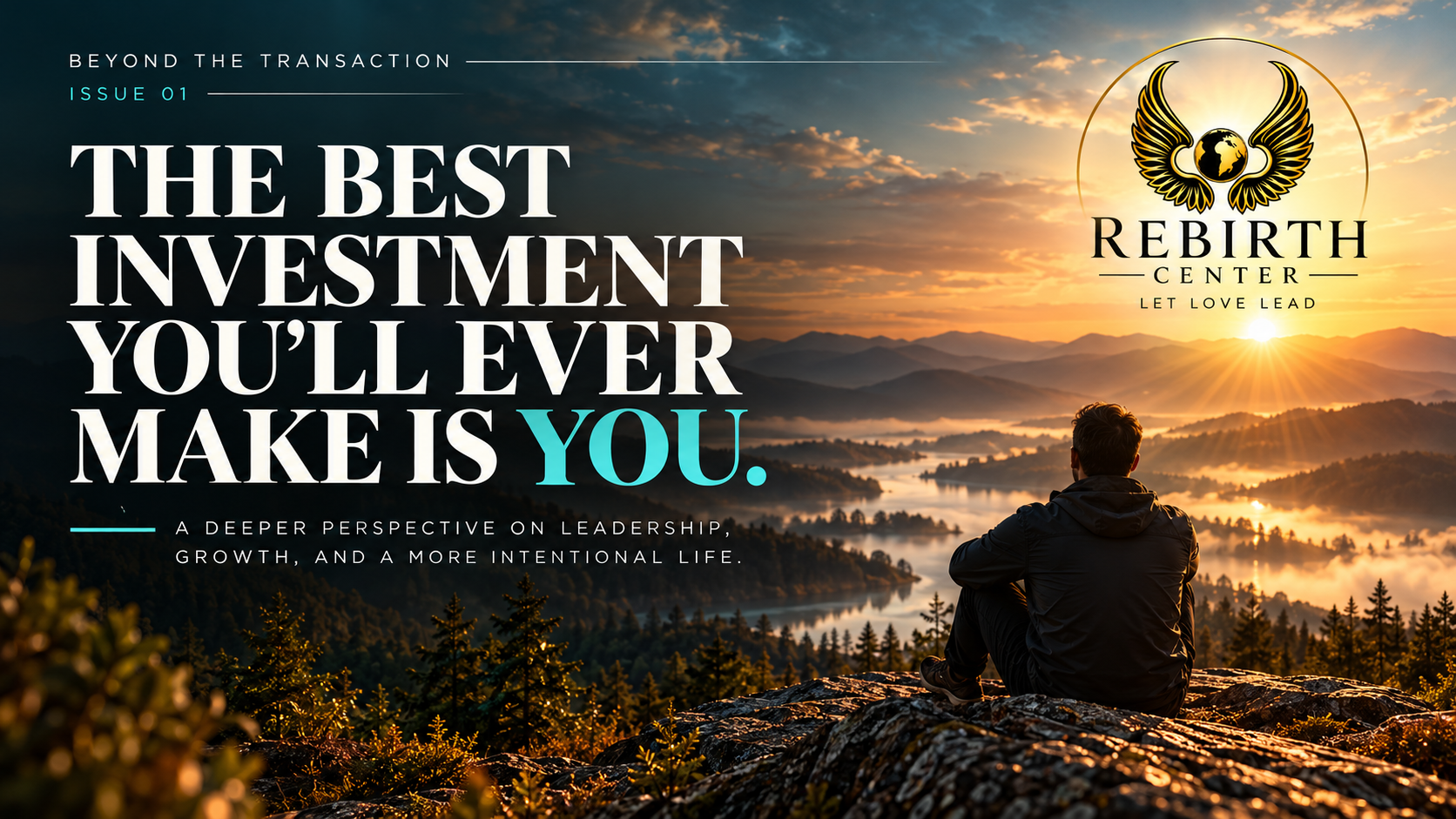
We spend our lives investing in businesses, careers, homes, markets, and opportunities. But how much do we invest in the one asset that influences every single part of our lives? Ourselves.
I've spent more than three decades in business, much of it building companies, developing technology, leading teams, and navigating the constant challenges of entrepreneurship.
Over those years, I've made plenty of investments.
Some paid off. Others didn't.
Some created financial returns. Others delivered expensive lessons.
But when I look back at the investments that have had the greatest impact on my life, the answer is surprisingly simple.
The best money I've ever spent was money I invested in myself.
Not in another company. Not in another financial opportunity. Not in another material possession.
In myself.
And the returns have been extraordinary.
We Invest in Everything Except Ourselves
Think about how easily we justify spending money on things we believe will improve our lives.
We invest in homes, cars, technology, vacations, business ventures, and financial portfolios.
We pay consultants to improve our companies. We hire experts to optimize operations. We invest in tools designed to make us more productive.
Yet when it comes to investing in our own emotional, physical, intellectual, and creative development, something interesting happens.
We hesitate.
We convince ourselves we're too busy. That it's too expensive. That we'll get around to it when things settle down.
But things rarely settle down.
There is always another deadline, another opportunity, another challenge, another obligation.
And somewhere along the way, we begin treating our own well-being and development as something optional.
We've become exceptionally good at investing in what we do, while often neglecting who we are.
The Investments That Changed My Life
Over the years, I've invested in physical trainers, therapists, leadership development programs, books, workshops, retreats, and countless other experiences focused on personal and professional growth.
Some helped me become a better leader.
Others helped me understand my own behaviors, emotional responses, fears, expectations, and limitations.
Some challenged beliefs I'd carried for decades.
Others simply helped me become more comfortable being myself.
Not every experience was easy. In fact, some of the most valuable were the most uncomfortable.
Because meaningful growth often requires confronting the parts of ourselves we'd rather avoid.
But I also discovered something else.
Personal development doesn't always need to look like traditional self-improvement.
Sometimes it looks like learning something completely unrelated to your career.
I've taken classes in blacksmithing, pottery, stained glass, and other creative disciplines.
Not because I intended to become a professional artist or craftsman.
But because I wanted to experience something different.
To work with my hands. To learn something unfamiliar. To create something without worrying about whether it would generate a return.
Those experiences taught me patience, curiosity, humility, and the freedom to be a beginner again.
They created lasting memories and opened up creative perspectives that don't always emerge in a boardroom or business meeting.
Music lessons. Dance classes. Painting. Woodworking. Learning a language. Exploring nature.
These aren't simply hobbies.
They are opportunities to reconnect with parts of ourselves that often get buried beneath responsibilities, expectations, and routines.
And sometimes, the most valuable thing you can do for your professional life is spend time doing something that has absolutely nothing to do with your profession.
The Hidden Cost of Being an Overachiever
Entrepreneurs, executives, professional athletes, business owners, and ambitious professionals often share a common characteristic.
We place enormous expectations on ourselves.
We want to perform. To improve. To achieve. To win. To build something meaningful.
And there's nothing inherently wrong with ambition.
Ambition has fueled extraordinary innovation, progress, and achievement.
But ambition without awareness can become destructive.
We begin measuring our worth through productivity, financial performance, recognition, and accomplishments.
We tell ourselves we'll slow down after the next milestone.
After the next funding round.
After the next promotion.
After the business becomes profitable.
After we've finally achieved whatever definition of success we've established for ourselves.
Except the finish line keeps moving.
And the pressure never really disappears.
Over time, this can create anxiety, exhaustion, emotional disconnection, frustration, and an inability to appreciate the very life we're working so hard to build.
The tragedy isn't that we're unsuccessful. It's that we can become incredibly successful while feeling increasingly disconnected from ourselves.
And the consequences rarely stop with us.
The People We Love Often Pay the Price
This is one of the hardest realities to acknowledge.
When we're overwhelmed, distracted, anxious, or emotionally exhausted, the people closest to us often experience the consequences.
Our partners.
Our children.
Our families.
Our friends.
Even our pets.
They don't necessarily experience the ambitious, accomplished, charismatic version of us that the professional world sees.
They may get whatever energy, attention, patience, and emotional capacity we have left at the end of the day.
And sometimes, that isn't very much.
We can be exceptional leaders in the workplace while struggling to be fully present at home.
We can build successful companies while neglecting meaningful relationships.
We can spend our lives creating financial security for people we love while unintentionally becoming less available to them.
I don't believe most people choose this intentionally.
I think many of us simply never learned another way.
We were taught how to work hard.
How to compete.
How to achieve.
How to push through adversity.
But how many of us were taught how to understand ourselves?
How to recognize emotional patterns?
How to communicate openly?
How to create healthy boundaries?
How to be present?
How to define success beyond what we accomplish?
These are not secondary life skills.
They influence nearly every relationship, decision, and experience we have.
And they deserve the same level of attention and investment we give to our professional ambitions.
You Don't Have to Choose Between Success and Fulfillment
One of the beliefs I've become increasingly passionate about challenging is that meaningful success requires sacrificing everything else.
That being a great entrepreneur means being constantly available.
That leadership requires carrying every burden.
That productivity means filling every available hour.
That slowing down somehow means falling behind.
I don't believe any of that has to be true.
I believe it's entirely possible to be ambitious, successful, productive, and purposeful while also being emotionally connected, physically healthy, creatively engaged, and genuinely present for the people who matter most.
But it rarely happens accidentally.
It requires intention.
It requires self-awareness.
It requires learning how we operate, why we react the way we do, what drives our behavior, and what we actually want our lives to look like.
And it requires the willingness to invest in ourselves with the same seriousness we invest in our careers.
The objective isn't to become less ambitious. It's to become more intentional about what our ambition is serving.
Why I Helped Build Rebirth
This philosophy is a significant part of what led me to help create Rebirth.
Not another traditional business venture.
Something much more personal.
I wanted to help create a place where people could temporarily step away from the noise, pressure, expectations, and constant demands of everyday life.
A place immersed in nature.
A place where individuals, couples, and leaders could slow down long enough to reconnect with themselves and with one another.
A place where experiences become opportunities for reflection.
Where creative activities reveal how we approach unfamiliar challenges.
Where conversations help us understand our expectations, behaviors, and relationships.
Where stepping outside familiar routines creates space for new perspectives.
Because sometimes, learning who we are requires stepping away from everything we normally do.
The vision behind Rebirth isn't about escaping life.
It's about becoming more intentional in how we live it.
It's about helping people explore three fundamental questions:
Who am I today?
How am I showing up in my life and relationships?
Who do I want to become?
Those questions are relevant whether you're a CEO, a professional athlete, an entrepreneur, a parent, a partner, or someone simply trying to navigate the complexities of everyday life.
We all carry expectations.
We all develop habits and patterns.
We all experience moments of disconnection.
And we all have the capacity to grow.
Personal Growth Is Not a Destination. It's a Practice.
Perhaps the most important lesson I've learned is that personal development isn't something you complete.
You don't attend one retreat, read one book, complete one leadership course, or spend six months with a therapist and suddenly become the finished version of yourself.
There is no finished version.
Life changes.
Relationships evolve.
Our priorities shift.
We encounter new challenges, opportunities, losses, and experiences.
And every stage of life presents another opportunity to learn something about ourselves.
The real value comes from creating an ongoing practice of growth.
Sometimes that means working with a therapist or coach.
Sometimes it means committing to physical fitness.
Sometimes it means learning an instrument, taking an art class, reading a challenging book, or having a difficult conversation.
Sometimes it means spending a weekend in nature without your phone.
And sometimes it simply means being willing to sit quietly with yourself and ask questions you haven't wanted to answer.
The investment doesn't always need to be financial.
Time, attention, vulnerability, curiosity, and intentional effort are investments too.
What matters is making them consistently.
The Return on Investment That Matters Most
In business, we spend an extraordinary amount of time measuring returns.
Revenue growth.
Profit margins.
Valuations.
Market share.
Productivity.
Efficiency.
But imagine evaluating the return on your personal investments differently.
Are you more patient with your partner?
More present with your children?
More understanding of your colleagues?
More confident in your decisions?
More comfortable with uncertainty?
More willing to explore unfamiliar experiences?
Better able to navigate conflict?
More connected to what genuinely matters to you?
These returns don't appear on a balance sheet.
But they influence nearly every part of our lives.
They make us better leaders, partners, parents, friends, and human beings.
And unlike many financial investments, their benefits can extend far beyond ourselves.
Because when we become healthier, more self-aware, more compassionate, and more intentional, the people around us benefit too.
That's a return worth pursuing.
My Challenge to You
Think about the last significant investment you made.
Maybe it was a new vehicle, a home improvement, a business opportunity, or another financial asset.
Now ask yourself something different.
When was the last time you made a meaningful investment in becoming a better version of yourself?
Not because your employer required it.
Not because it would look good on your résumé.
Not because it would help you close another deal.
But because you believed you were worth the investment.
Maybe it's time to hire that trainer.
Schedule that therapy session.
Take the music lessons you've been putting off.
Sign up for a pottery class.
Spend a weekend at a retreat.
Read a book that challenges your assumptions.
Or simply give yourself permission to explore something new.
Whatever it is, start.
And then keep going.
Because the most valuable investment you will ever make isn't necessarily the one that increases your net worth.
It's the one that improves the quality of your life and the lives of the people you love.
Invest in yourself. Not once. Not occasionally. Make it a lifelong practice.
The returns may be greater than you ever imagined.