

I've spent more than three decades in the payments industry watching technology transform the way businesses operate.
We've moved from standalone credit card terminals to sophisticated platforms managing nearly every aspect of a merchant's operations.
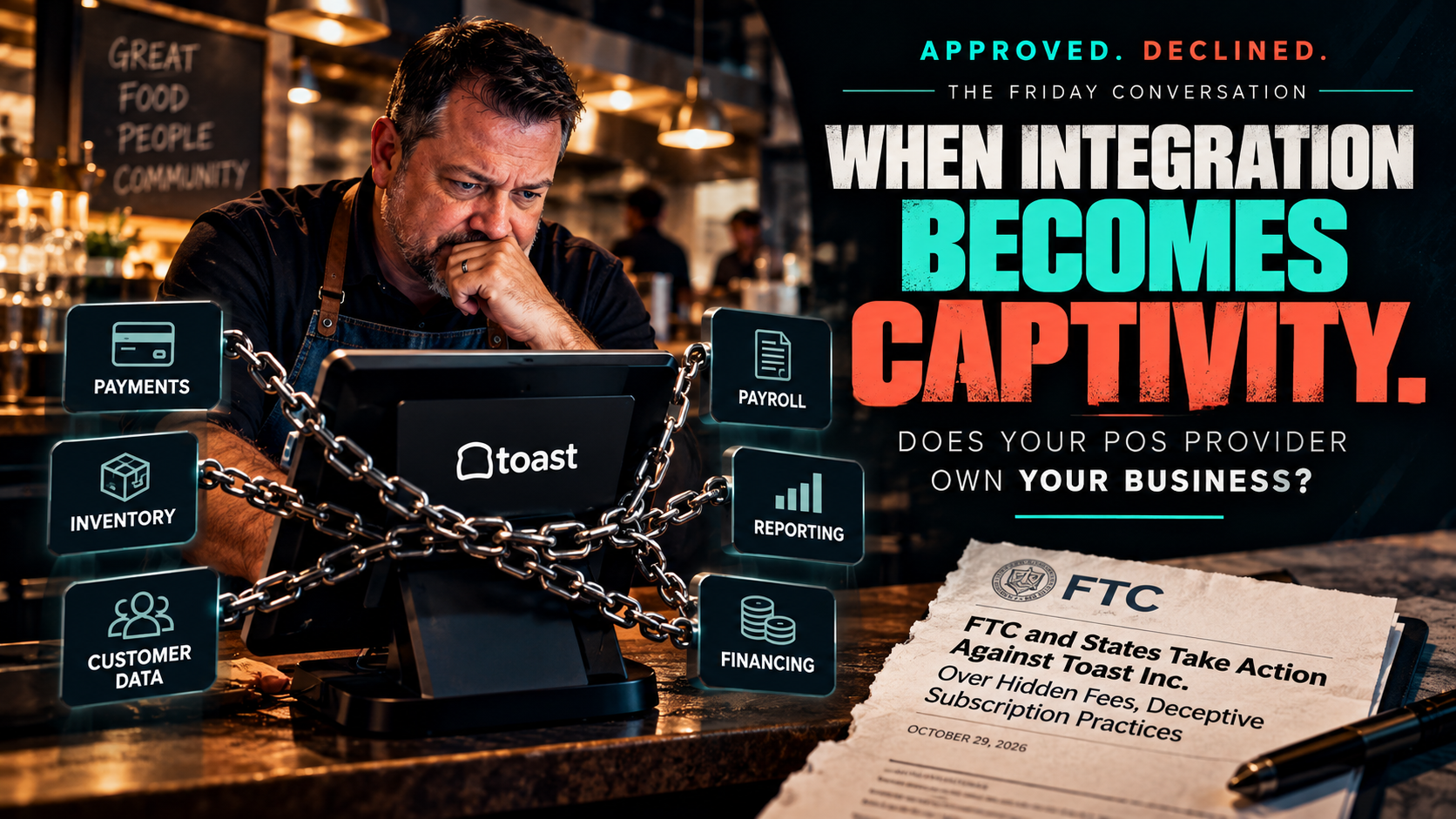
Point of sale. Inventory. Payroll. Accounting. Customer relationships. Payments. Financing.
And much of that innovation has been genuinely remarkable.
But I've also watched something happen that I believe should concern every business owner, payments professional, and technology executive.
We've created an industry where the technology that's supposed to empower businesses can also become the very thing that prevents them from making independent decisions.
And yesterday's announcement from the Federal Trade Commission involving Toast brings that concern directly into the spotlight.
The Toast Lawsuit: A Wake-Up Call
On October 29, 2026, the FTC and state and local authorities filed a lawsuit against Toast and affiliated entities.
The complaint alleges hidden and unauthorized charges, unwanted subscription add-ons, misleading representations about support, and cancellation practices that made it difficult and expensive for restaurants to leave.
Among the allegations are:
- Early termination charges calculated at $150 for every remaining contract month.
- A reported $5,318.87 termination charge imposed on one customer.
- A $0.99 fee added to certain online orders, allegedly without adequate disclosure or consent.
- Cancellation procedures that allegedly resulted in continued billing.
- Outstanding Toast Capital loans becoming immediately payable when customers canceled or switched providers.
These are allegations, not proven violations. The case is pending.
Toast strongly disputes the allegations and says it will vigorously defend itself. The company also argues that the FTC is attempting to apply a consumer-focused subscription law to negotiated business-to-business contracts, a legal interpretation Toast contests.
That dispute deserves its day in court.
But regardless of the eventual outcome, the case highlights a much broader issue that I believe our industry needs to confront.
When Integration Becomes Dependency
Let's consider a hypothetical restaurant.
The owner signs up for a modern POS platform.
It looks fantastic.
Ordering, inventory, employee scheduling, payroll, online ordering, reporting, and payment processing all work together.
One provider. One integrated system. One technology ecosystem.
Sounds ideal.
And for many businesses, it genuinely is.
But then something changes.
The merchant becomes unhappy with their payment processing costs.
Or customer service deteriorates.
Or a competitor offers better pricing, features, or technology.
Naturally, the owner wants to explore alternatives.
Except now the owner discovers that changing payment processors isn't simply a matter of selecting another provider.
Their POS is tied to the processor.
Their online ordering is integrated into the platform.
Their employee workflows depend on it.
Their reporting and transaction histories are embedded in it.
And their financing agreement may introduce additional restrictions.
Suddenly, changing payment providers means potentially replacing the operational infrastructure of the entire business.
That's not simply switching costs. That's operational dependency.
And when that dependency becomes the primary reason a merchant stays with a provider, I believe we've crossed a line.
I Have Never Liked Forced Payment Processing
Let me be clear.
I have no objection to technology companies offering integrated payments.
Embedded payments can simplify operations, improve reporting, accelerate onboarding, and create meaningful value.
My objection is to systems that require businesses to use one payment provider without a practical option to choose another.
A merchant should be able to select the POS, ERP, or business management software that best meets their operational needs.
And they should be able to select the payment provider that delivers the best combination of economics, service, security, reliability, and functionality.
Those decisions should complement one another.
They should not be inseparable by design.
Because the moment a software company can prevent a merchant from changing processors, something fundamental changes.
The provider no longer has to compete for that merchant's payment business in quite the same way.
The merchant's ability to negotiate becomes weaker.
And the economic incentive to retain the relationship through excellent service and competitive pricing can diminish.
A merchant who stays because they love your product is a customer. A merchant who stays because leaving would disrupt their business is something very different.
The Economics Behind the Lock-In
Let's talk about why this model is so attractive.
Payments generate recurring revenue.
Unlike a software license that may have a relatively predictable monthly price, payment processing revenue generally grows with a merchant's transaction activity.
The more the merchant sells, the more payment volume moves through the platform.
And depending on the pricing structure, the provider can earn revenue from transaction fees, software subscriptions, hardware, financing, and other services.
There is nothing inherently wrong with that.
Businesses should be compensated for delivering value.
But when a technology provider controls both the operational system and the payment rails, it can gain significant leverage over the merchant relationship.
Consider a hypothetical merchant processing $100,000 per month.
A difference of just 25 basis points in effective payment pricing represents $250 per month, or $3,000 annually.
A 50-basis-point difference represents $6,000 annually.
Now imagine the merchant discovers a more competitive offer but cannot adopt it without replacing the entire POS infrastructure.
New hardware.
Employee training.
Data migration.
Integration testing.
Potential downtime.
Operational disruption.
And possibly contractual obligations.
How many merchants will decide it's simply not worth the trouble?
That's the real economic power of platform dependency.
Not every integrated provider abuses that power. But the structure can make it harder for merchants to exercise competitive choice.
The Cost of Inaction
This is also where merchants need to take greater responsibility for their technology decisions.
Too often, the purchasing decision is driven by what the system can do today.
How easy is the demonstration?
How attractive is the introductory pricing?
How quickly can we get operational?
How many functions can we consolidate?
Those are reasonable questions.
But they're incomplete.
The questions merchants should also ask are:
Can I change payment processors without replacing the software?
Who owns my customer, transaction, and operational data?
Can I export that data in a usable format?
What happens if I cancel?
Will outstanding financing obligations change if I switch providers?
What is the total cost of leaving this platform?
These questions should be answered before a contract is signed, not after the relationship deteriorates.
Because the cost of a technology decision isn't just what you pay to get started.
It's also what you surrender in flexibility.
The Industry Needs to Stop Confusing Integration With Ownership
I believe the next generation of business technology should be built around interoperability, portability, and merchant choice.
A POS provider should compete on the strength of its POS technology.
An ERP provider should compete on the quality of its operational capabilities.
A payment processor should compete on economics, service, reliability, and innovation.
And when those services work better together, merchants should benefit from the integration.
But they shouldn't have to surrender their independence to receive it.
I recognize that supporting multiple processors introduces real technical complexity, certification requirements, security considerations, and support costs.
An open architecture isn't automatically cheaper or better.
And an integrated provider isn't automatically exploiting its customers.
The question is whether the benefits of integration justify the limitations placed on the merchant.
And whether those limitations are transparent, proportionate, and commercially reasonable.
My Verdict: Declined.
The idea that a business should have to replace its operational infrastructure simply because it wants to change payment processors?
DECLINED.
The idea that a technology provider should be able to use operational dependency as a substitute for competitive value?
DECLINED.
And the idea that merchants should discover the true cost of leaving only after they've built their businesses around a platform?
Absolutely declined.
This isn't just about Toast.
It's about the future of embedded finance, vertical SaaS, POS systems, ERP platforms, and merchant acquiring.
We should be building technology that makes businesses more capable, more competitive, and more independent.
Not technology that makes them increasingly dependent on one provider.
The best technology relationship is one a merchant chooses to renew—not one they're afraid to leave.
The Friday Conversation
I want to hear from POS providers, payment processors, ISOs, software developers, merchants, and embedded-finance executives.
Should business software companies be able to require merchants to use their payment processing services?
APPROVED: Fully integrated platforms deliver enough value to justify a closed ecosystem.
DECLINED: Merchants should always have the freedom to choose their payment processor.
IT DEPENDS: Closed ecosystems can work, but pricing, contracts, and exit rights must be transparent.
I'm particularly interested in hearing from those building and selling these platforms.
What am I missing?
Where does integration end and merchant lock-in begin?
Let's have the conversation.
Noah Fitzgerald, CPP
Approved. Declined. — The Friday Conversation
Source: Federal Trade Commission, October 29, 2026, FTC and States Take Action Against Toast Inc. The allegations remain contested and unresolved. Toast disputes the claims and challenges the FTC's interpretation of the applicable subscription law.