

After more than 30 years in the payments industry, I've watched technologies evolve, business models transform, and countless innovations change how merchants and consumers transact.
But there's one trend that I believe represents a significant step backward.
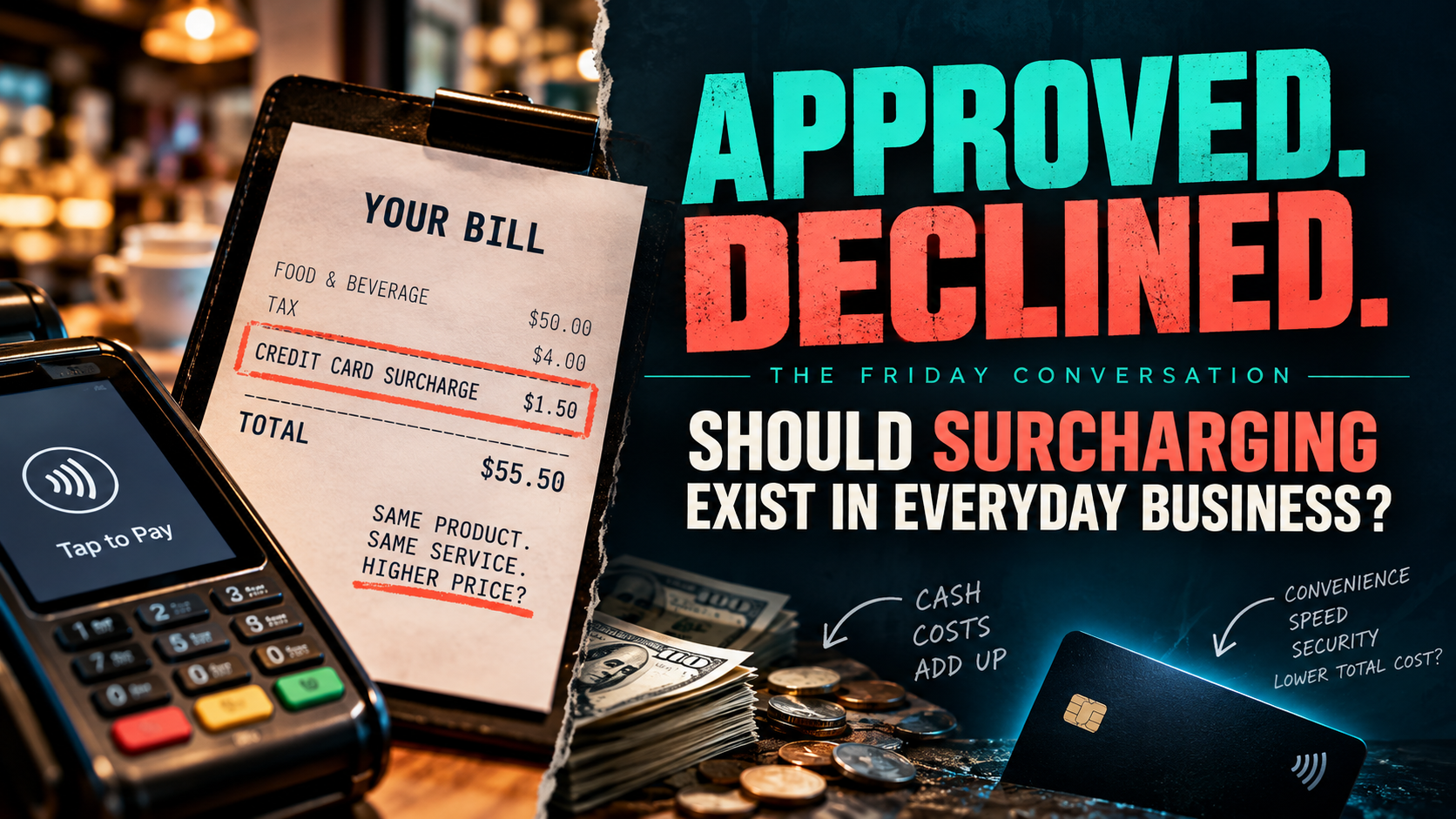
The explosion of credit card surcharging and cash discounting in everyday consumer businesses.
And I'm going to say something that might upset a few people in my industry.
I believe much of this movement has been driven less by the interests of merchants and more by payment sales organizations looking for an easier sale and a more profitable revenue model.
We've convinced merchants that accepting electronic payments is an expense they should push onto their customers, often without helping them understand the true costs of the alternatives.
And in doing so, I believe we're damaging the very industry we've spent decades building.
Let's Get Something Straight: I'm Not Against All Surcharging
There are legitimate business environments where surcharging, convenience fees, or other compliant cost-recovery arrangements can make economic sense.
Large-ticket B2B transactions. Wholesale distribution. Nonprofits. Utilities. Government payments. Education. Industries with exceptionally thin margins or where transparent, separately disclosed payment costs serve a genuine purpose.
These environments can have very different economics, contractual arrangements, and customer expectations.
But that's not what I'm talking about.
I'm talking about restaurants adding 3% to your dinner bill.
Convenience stores charging extra for a bottle of water.
Auto repair shops, salons, neighborhood retailers, and countless other consumer-facing businesses turning the payment method into another fee.
When did accepting a customer's money become something we charge the customer extra for?
Cash Isn't Free. Not Even Close.
Here's where I believe the payments industry has done merchants a tremendous disservice.
We talk endlessly about interchange, assessments, processing fees, and effective rates.
But how often do we sit down with a merchant and explain the actual cost of accepting cash?
Cash has costs. Significant ones.
It needs to be counted, reconciled, secured, transported, deposited, and protected against theft.
Employees make mistakes. Cash disappears. Counterfeit bills get accepted. Managers spend time balancing drawers instead of running their businesses.
And customers wait while someone counts change, searches for a manager, or figures out why the register is short.
Yet somehow we've convinced merchants that credit cards are the expensive payment method.
Let's look at a practical example.
The $25,000-a-Month Merchant: What Are We Really Saving?
Consider a small retail business processing $25,000 per month.
At an illustrative 2.5% effective processing rate, electronic payment acceptance costs approximately $625 per month .
That's the number the salesperson points to.
"Mr. Merchant, I can eliminate that $625 expense!"
Sounds compelling.
But what happens when we compare it against the operational costs of handling the same $25,000 in cash?
| Cash handling expense | Illustrative monthly cost |
|---|---|
| Bank cash deposits: $20,000 above a $5,000 allowance at $0.30 per $100 | $60 |
| Armored transportation service | $800 |
| Cash shrinkage at an assumed 0.50% | $125 |
| Employee cash management: 15 hours at $15/hour | $225 |
| Security equipment and related costs | $50 |
| Counterfeit exposure, insurance and miscellaneous | $20 |
| Total with armored service | $1,280 |
| Total without armored service | $480 |
These are illustrative assumptions, not universal industry averages. Actual costs depend on cash volume, location, deposit arrangements, staffing, security requirements, and operating practices.
The example deliberately assumes the same sales volume is handled entirely by either payment method. Most businesses operate with a mixture, so a proper comparison should focus on the incremental costs and benefits of each payment method rather than treating all overhead as avoidable.
But the point remains.
Before you declare that card processing is too expensive, have you calculated what accepting cash actually costs your business?
In this example, the business using armored transportation could spend considerably more managing cash than accepting electronic payments.
Even without armored transportation, the costs are meaningful before accounting for lost productivity, reconciliation errors, or customer experience.
And that brings me to something that rarely appears in a processing proposal.
What Is Your Customer's Time Worth?
Think about the last time you stood in line at a convenience store.
The person in front of you hands the cashier a twenty-dollar bill.
The cashier checks the denomination, opens the drawer, counts the change, realizes they're short on singles, and asks another employee for help.
Meanwhile, four people are waiting.
Now compare that with a contactless payment.
Tap. Approved. Done.
A card tap can take only seconds, although the complete checkout experience depends on the terminal, transaction, and cashier workflow. Cash transactions can also be fast, so there's no single universal timing comparison.
But the broader operational question is undeniable.
How much labor and customer throughput can a business gain from faster, more predictable transactions?
What happens to customer satisfaction when checkout becomes a bottleneck?
What is the cost of losing a customer who decides the line isn't worth waiting in?
These are real business considerations.
Yet the salesperson pitching a surcharge program rarely includes them in the presentation.
If We're Going to Surcharge for Payments, Where Does It Stop?
This is the question I want every business owner to consider.
Payment processing is an operating expense.
So is payroll.
So is rent.
So is electricity.
So is insurance, marketing, legal counsel, accounting, and the software used to run the business.
Imagine walking into a restaurant and seeing this on your receipt:
- Food and beverages: $50.00
- Credit card surcharge: $1.50
- Employee payroll recovery: $2.00
- Rent recovery fee: $1.75
- Electricity adjustment: $0.85
- Insurance recovery fee: $0.50
Absurd?
Then why have we decided that payment processing is somehow different from every other cost of operating a business?
Businesses have always had a responsibility to understand their expenses and price their products and services accordingly.
If accepting payments costs 2.5%, factor that into your pricing strategy.
Just as you do with rent, labor, insurance, and everything else required to serve your customers.
I would much rather pay $20 for a product advertised at $20 than discover at checkout that the actual price is $20.60 because I chose to use a credit card.
It's not about the sixty cents.
It's about transparency, trust, and the customer experience.
The Payments Industry Needs to Look in the Mirror
Here's the uncomfortable part.
I don't blame every merchant who adopts surcharging.
Many have been sold a compelling proposition.
"Eliminate your processing fees."
"Keep more of every sale."
"Stop paying the credit card companies."
Who wouldn't want to reduce expenses?
But where is the conversation about the full economics of payment acceptance?
Where is the analysis of customer friction?
Where is the discussion about brand perception, checkout abandonment, or the possibility of losing repeat business?
And where is the disclosure that some sales organizations have a significant financial incentive to promote these programs?
I'm not suggesting every surcharge provider is acting irresponsibly. Many offer compliant programs, explain the tradeoffs, and genuinely help merchants manage expenses.
But I believe a portion of our industry has turned surcharging into a sales shortcut rather than a thoughtful merchant advisory decision.
When a salesperson makes more money by convincing a merchant to charge their customers extra, we should be asking whose interests are really being served.
The merchant's?
The customer's?
Or the payment company's?
Why Aren't the Biggest Retailers Doing It?
Look at major consumer-facing retailers such as Walmart, Target, and Amazon.
They have enormous payment acceptance expenses.
Yet broad credit card surcharging has not become their standard everyday retail checkout model.
Why?
I believe these companies understand something that many smaller merchants aren't being encouraged to consider.
The customer experience has value.
Pricing clarity has value.
Brand trust has value.
And making a customer feel penalized for their preferred payment method can create friction that far outweighs the processing expense being recovered.
Large retailers also have scale, negotiating leverage, and payment economics that differ substantially from those of small merchants. Their choices are not proof that surcharging never makes financial sense.
But their approach should prompt an important question.
If some of the world's largest retailers choose to absorb payment acceptance costs into their business models, why are we telling neighborhood merchants they can't afford to do the same?
Just Because It's Permitted Doesn't Mean It's Good Business
Surcharging is permitted in many U.S. jurisdictions, subject to applicable laws and card-network requirements. Other jurisdictions restrict or prohibit it.
Visa generally limits eligible U.S. credit card surcharges to the merchant's applicable acceptance cost or 3%, whichever is lower. Mastercard also imposes cost-based limits and its own maximum cap. Neither network permits surcharging its debit cards under the ordinary U.S. surcharge rules.
Cash discounts, dual pricing, convenience fees, and credit card surcharges are not legally interchangeable. Each requires its own analysis of applicable rules.
These restrictions matter, and merchants deserve accurate guidance.
But legal permission and sound business strategy are two different things.
We should not measure the quality of a payment solution solely by whether we can implement it.
We should measure it by whether it creates lasting value for the merchant and their customers.
My Verdict: Declined.
I believe surcharging has a legitimate place in certain industries and transaction environments.
But as a default strategy for everyday consumer businesses?
DECLINED.
Not because merchants shouldn't manage expenses.
Not because payment processing is inexpensive.
And certainly not because the card networks are beyond criticism. Interchange complexity, pricing opacity, and rising acceptance costs deserve their own serious debate.
I reject it because I believe we've lost sight of the value that electronic payments deliver.
Convenience. Security. Efficiency. Speed. Recordkeeping. Reduced cash handling. Access to customers who might otherwise walk away.
Those benefits aren't free.
But neither is cash.
And before we tell merchants that shifting payment costs onto their customers is the answer, perhaps we should spend more time helping them understand the actual economics of their business.
After more than three decades in payments, I believe our industry's responsibility should be to make commerce easier, more efficient, and more transparent.
Not to create another fee at checkout.
Now It's Your Turn
I know plenty of people in my network sell surcharge and cash discount programs.
Some of you have built successful businesses around them.
I genuinely want to hear your perspective.
Am I wrong? Is surcharging a legitimate evolution in merchant pricing, or has our industry created a problem in pursuit of another revenue opportunity?
APPROVED: Merchants should be able to pass payment acceptance costs directly to customers.
DECLINED: Payment acceptance is a cost of doing business and belongs in the price.
IT DEPENDS: There are legitimate use cases, but everyday retail has taken it too far.
Disagree with me. Challenge my assumptions. Show me the economics I'm missing.
That's exactly why I created Approved. Declined.
The Decisions. The Disruptions. The Stories Behind the Transactions.
Noah Fitzgerald, CPP — 30+ years in payments, fintech, and merchant acquiring.
Supporting Resources: Visa — U.S. Merchant Surcharging Q&A